
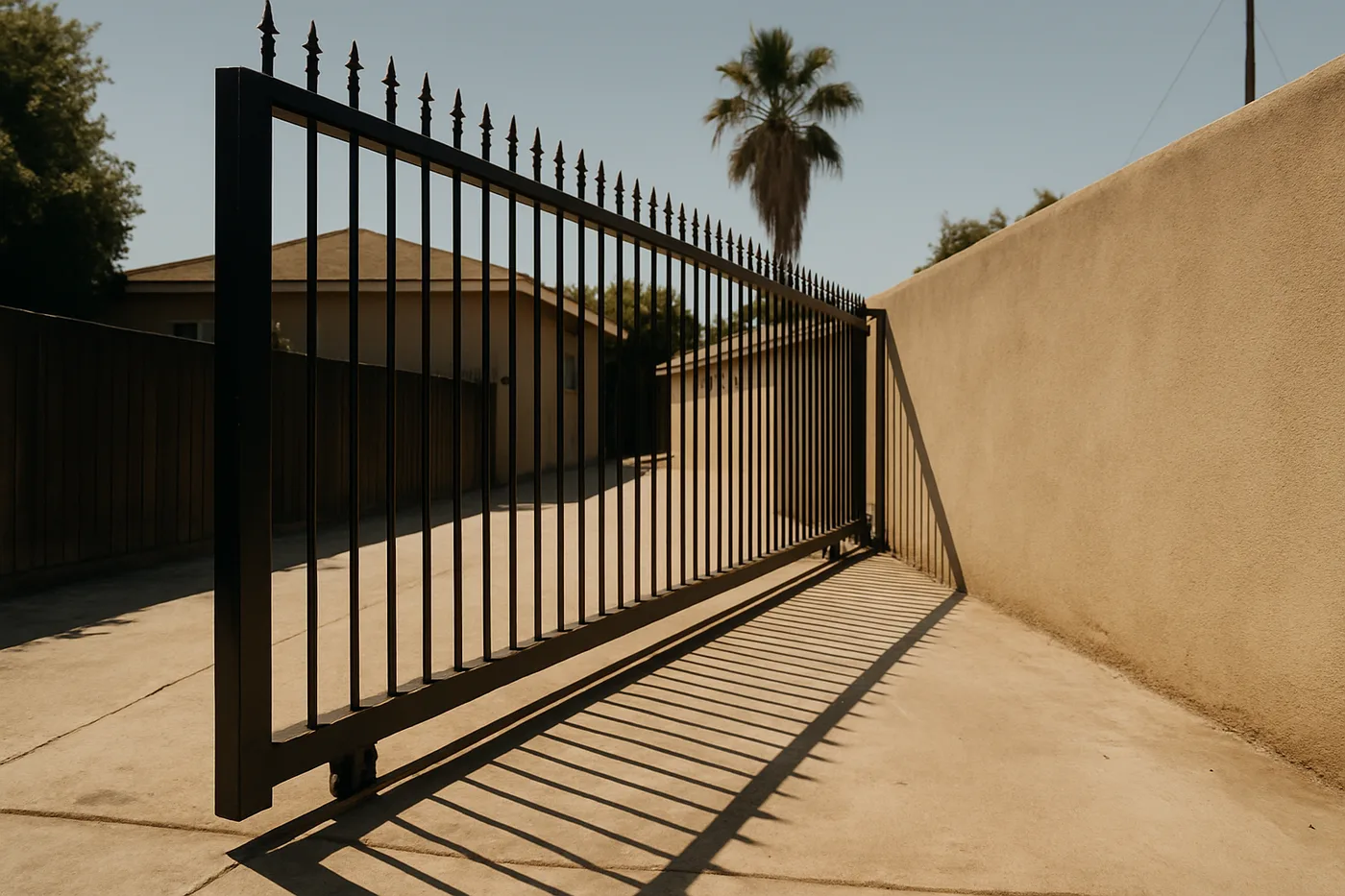
Sliding Gate Installation in Los Angeles, CA
Sliding Gates Installed Where Swing Gates Cannot Work
Run space measured on-site before track or cantilever system is chosen.
Get Your Free Estimate Today
We follow up the same business day.
Request received
We'll follow up shortly. Need it sooner? Call 844-997-7555.
When a Sliding Gate Is the Right Answer
A sliding gate moves parallel to your property line, not into your driveway, your sidewalk, or a parked car.
That distinction matters more in Los Angeles than almost anywhere else in California. Lots are narrow. Driveways are short. Swing gates need clear arc space that many LA properties simply don't have. A sliding gate eliminates that problem by retracting along the fence line instead of swinging open.
Iron Men Gates and Doors Design installs both track-based and cantilever sliding gate systems across Los Angeles. We've handled these installations since 2014, on residential driveways, commercial yards, and everything between. The system we recommend depends on your specific site, not on what's simplest to install.
Rolling gate installation in LA requires a real look at your driveway surface, your available run space, and your gate opening width. That assessment happens before any hardware is ordered.
What LA Driveways Actually Require
Los Angeles has some of the most varied residential lot conditions in the state, and sliding gates respond to every one of them differently.
Koreatown
Many driveways open directly onto sidewalks, leaving almost no safe swing arc.
East Hollywood
Lots sit close together, and a swing gate would conflict with neighboring fences or vehicles parked against the property line.
Chatsworth
Longer residential runs give more lateral space, but sloped concrete can rule out ground-track systems entirely.
Here's what many homeowners discover about sliding gates in Los Angeles: the track isn't always the lower-cost option once you factor in concrete cutting on pavement that's already showing age. Older asphalt driveways in mid-city neighborhoods often can't accept a V-groove track, a steel rail with a V-shaped groove that receives matching V-groove rollers on the gate bottom, without cracking during installation or heaving within the first rainy season. That's a condition we assess on every site before committing to a system.
What I Saw on a Chatsworth Cantilever Job
The right sliding gate system isn't always obvious until you're standing in the driveway looking at the numbers.
Yaron Eliya, Owner, Iron Men Gates and Doors Design
A few years back, I got a call from a homeowner in Chatsworth who'd already had the gate opening measured and a track-based sliding gate quoted. The opening was 14 feet wide. The driveway was concrete. On paper, a track installation made sense.
When I got there, I walked the driveway with a tape measure and a level. The slope was steeper than it looked from the street, about a 4% grade running toward the street, which is right at the threshold where V-groove track systems start to bind under a loaded gate. The gate this homeowner wanted was custom iron, which put the panel in the 600-pound range.
A track-based system at that weight, on that grade, with that surface condition? The rollers would wear out within two years. The track would collect debris running downhill with every rain. Any ground heave during a wet winter would throw the whole system out of alignment.
I recommended a cantilever sliding gate, a system where the gate suspends from rollers mounted on a structural post, with no ground contact at all. A cantilever configuration requires a counterbalance run behind the latch post equal to roughly 50 to 60% of the gate panel width. For a 14-foot gate, that meant about 8 feet of clear run space beside the opening. The homeowner had it. We installed the cantilever system, connected it to a motor drive unit, the rack-and-chain operator that powers the gate along its travel path, and the gate has run clean for three years.
That's the kind of site read that only happens when you actually measure before you spec.
How We Handle Automated Sliding Gate Setup
Motorizing a sliding gate is straightforward, once the gate type and weight are confirmed.
Some customers ask whether they need to choose their access control system before we install the gate. The answer is no. The motor drive unit is installed as part of the sliding gate setup, and the access system, whether that's a keypad, remote, or intercom integration, connects after the gate is running. You don't need everything decided on day one.
What does need to be decided before installation is the gate panel weight. Every automatic sliding gate setup in LA runs on a motor drive unit sized to the gate's weight and travel speed. A light aluminum panel and a heavy ornamental iron panel each require different operators. We confirm weight and travel distance before any motor is ordered.
That sequencing keeps the installation clean and avoids the cost of replacing an undersized operator after the gate is already hung.

Our Standards for Sliding Gate Installation
Every sliding gate we install is built to carry its rated load for the long term, not just to pass a quick test on installation day.
- Site measurement first. Gate run space, the open fence or wall area the gate retracts into when fully open, is measured before track or cantilever is specified. It must equal at least the gate panel width.
- Driveway surface compatibility check. Concrete, asphalt, and pavers each respond differently to track installation. We assess before we cut.
- Cantilever selected by slope and weight, not by default. Sloped driveways and heavy panels go cantilever. Flat surfaces with clean run space may accept a V-groove track system.
- Roller assembly torqued and tested under load. The roller assembly, the wheeled carriage that carries the gate along the track or suspension rail, is tested at full panel weight before any motor is connected.
- Motor drive unit matched to panel weight. Chain-drive and direct-drive options are sized by gate mass, not by opening width alone.
- California Contractor License #1049550. Every installation is covered under a licensed contractor in the state.
How a Sliding Gate Installation Works
A sliding gate installation follows a clear sequence: site first, hardware second, programming last.
Diagnostics at the Site
We arrive with tape measures, a digital level, and a surface probe. Gate run space is measured on both sides of the opening. Driveway surface compatibility is evaluated by material type and existing condition. The slope angle is recorded. Gate opening width is confirmed against the planned panel size. Only after this is the system type, track-based or cantilever, finalized.
For track-based sliding gates: we mark the track centerline, confirm the depth of concrete or asphalt, and check for subsurface utilities before cutting begins.
For cantilever sliding gates: we confirm the post anchor locations and the counterbalance run length. The gate needs clear horizontal space equal to 50 to 60% of its width behind the latch post, with no vehicles, no landscaping, and no structure in that zone.
Installation
Track systems: concrete or asphalt is cut, the track is set, and a roller assembly is installed on the gate bottom. The gate is hung and tested for smooth travel before the motor is connected.
Cantilever systems: the suspension rail and support posts are anchored first. The roller assembly is mounted to the post. The gate panel is hung, balanced, and checked for level along its full travel path.
In both cases, the bottom rail receives a rack gear, the toothed metal strip the motor drive unit engages to push the gate along its path. Rack alignment is critical. A misaligned rack causes skipping, accelerated wear, and motor strain within months.
Testing Before Handoff
Once the motor drive unit is wired and programmed, we run the gate through 10 or more open and close cycles under manual observation. We check rack engagement at both ends of travel, confirm safety sensor placement, and verify that the limit stops, which tell the motor when to stop, are set precisely. We don't hand off the system until it runs clean.
Areas We Serve in Los Angeles
Iron Men Gates and Doors Design serves sliding gate installation projects across Los Angeles County.
We regularly work in East Hollywood, Koreatown, Silver Lake, Echo Park, Los Feliz, Mid-City, West Adams, Culver City, Burbank, North Hollywood, Van Nuys, Chatsworth, and surrounding communities. Sliding driveway gate projects across California urban and suburban neighborhoods are handled from our Los Angeles office.
- East Hollywood
- Koreatown
- Silver Lake
- Echo Park
- Los Feliz
- Mid-City
- West Adams
- Culver City
- Burbank
- North Hollywood
- Van Nuys
- Chatsworth
Frequently Asked Questions
Other work on the same driveway
Ready to Get Your Sliding Gate Installed?
If your driveway needs a gate that retracts along the fence line, we'll confirm which system fits your site before any work begins. Tell us your opening width and driveway surface, that's all we need to get started.
Book your site measurement
We follow up the same business day.
By submitting you agree to be contacted about your project. We never share your details.
Request received
We'll follow up shortly. Need it sooner? Call 844-997-7555.
Iron Men Gates and Doors Design|5520 Wilshire Blvd Unit 323, Los Angeles, CA 90036|CA License #1049550|844-997-7555